Choosing the right meeting room display is an important decision when setting up a modern conference room, training room, classroom or corporate collaboration space.
Today, customers can choose from different types of display technologies, including LCD interactive displays, interactive flat panels, large-format LCD displays and LED video walls.
One of the most common questions is:
Which meeting room display sizes use LCD, and when should you choose LED?
The answer mainly depends on the screen size, viewing distance, room size, installation environment and required display area.
In this guide, we explain the differences between LCD and LED meeting room displays and how to choose the right screen size for your project.
What Is an Interactive Meeting Room Display?
An interactive meeting room display is a large-format digital screen designed for meetings, presentations, video conferencing, collaboration and interactive whiteboarding.
Modern interactive displays commonly integrate:
- 4K resolution
- Touchscreen technology
- Built-in speakers
- Microphones
- Android operating system
- Wireless screen sharing
- Video conferencing
- Digital whiteboard software
- USB and HDMI connectivity
- Optional OPS PC
These features make an interactive flat panel display suitable for corporate meeting rooms, classrooms, training centers and conference facilities.
LCD vs LED: What Is the Difference?
The biggest difference is the display technology.
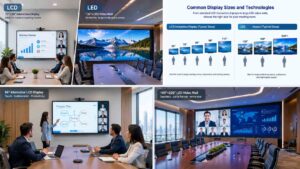
LCD Interactive Display
LCD meeting room displays use an LCD panel with LED backlighting.
They are commonly available in sizes such as:
- 55 inch
- 65 inch
- 75 inch
- 86 inch
- 98 inch
- 110 inch
For most standard meeting rooms, 65-inch, 75-inch and 86-inch interactive displays are particularly common choices.
LED Display
LED displays use individual LED pixels to create the image.
Unlike a conventional LCD panel, an LED display can be built into a much larger screen by combining multiple LED cabinets or modules.
Typical LED solutions include:
- 110 inch
- 136 inch
- 165 inch
- 220 inch
- 300 inch+
- Custom sizes
Therefore, when a customer needs a very large conference room screen, LED can become a more flexible solution.
What Size Meeting Room Display Should You Choose?
There is no single screen size that is suitable for every conference room.
The best size depends on:
- Meeting room dimensions
- Number of participants
- Viewing distance
- Type of content
- Required resolution
- Installation space
- Budget
Here is a simple reference:
| Display Size | Recommended Application |
|---|---|
| 55″ | Small meeting rooms |
| 65″ | Small conference rooms |
| 75″ | Medium meeting rooms |
| 86″ | Medium to large meeting rooms |
| 98″ | Large conference rooms |
| 110″ | Large meeting rooms |
| 136″+ LED | Large conference rooms / auditoriums |
| 165″+ LED | Large meeting spaces |
| 200″+ LED | Auditorium / training center |
These are general recommendations rather than strict rules. The actual choice should consider the room layout and viewing distance.
65-Inch Interactive Display: For Small Meeting Rooms
A 65-inch interactive display is a practical choice for small conference rooms and huddle rooms.
It is suitable for:
- Small business meetings
- Team collaboration
- Video conferences
- Presentation
- Digital whiteboarding
- Training
For rooms with a limited number of participants, a 65-inch LCD interactive display can provide a good balance between screen size and cost.
75-Inch Interactive Display: A Popular Conference Room Solution
A 75-inch interactive display is suitable for many medium-sized meeting rooms.
It provides a larger working area than a 65-inch display while still maintaining a relatively compact installation footprint.
Typical applications include:
- Corporate meeting rooms
- Training rooms
- Education
- Government offices
- Conference centers
- Remote meetings
A 75-inch interactive flat panel is also easy to integrate with video conferencing equipment and wireless presentation systems.
86-Inch Interactive Display: For Larger Meeting Rooms
An 86-inch interactive display provides a significantly larger viewing area and is suitable for larger conference rooms.
It can be used for:
- Corporate boardrooms
- Training rooms
- Large classrooms
- Video conferencing
- Business presentations
- Collaborative meetings
For customers who want a large LCD display but do not need a full LED video wall, an 86-inch interactive display can be a good solution.
98-Inch and 110-Inch LCD Displays
When the meeting room becomes larger, customers may consider 98-inch or 110-inch LCD displays.
These large-format LCD displays provide a much larger viewing area while maintaining the benefits of LCD technology.
However, as screen size increases, factors such as:
- Transportation
- Installation
- Wall strength
- Door and elevator dimensions
- Packaging
- Maintenance
also become increasingly important.
For very large screens, LED may offer greater flexibility.
When Should You Choose an LED Meeting Room Display?
For meeting rooms requiring a screen larger than approximately 110 inches, an LED display or LED video wall can become an attractive alternative to a large LCD panel.
LED is particularly suitable when the customer requires:
1. Very Large Screen Size
LED displays can be customized to create extremely large screens.
For example:
136″, 165″, 220″, 300″ or even larger.
2. Custom Aspect Ratios
Unlike fixed-size LCD panels, LED screens can be assembled into different dimensions.
For example:
3840 × 2160 mm
or
5120 × 2880 mm
depending on the project requirements.
3. High Brightness
LED displays can provide high brightness, making them suitable for larger rooms, auditoriums and spaces with strong ambient lighting.
4. Seamless Display
An LED video wall does not have the visible bezels that are normally found between multiple LCD panels.
This creates a continuous and seamless image.
LCD or LED for a Conference Room?
The choice between LCD and LED depends on the application.
| Feature | LCD Interactive Display | LED Display |
|---|---|---|
| Typical Size | 55″–110″ | 110″+ |
| Touch Function | Common | Optional |
| Installation | Relatively simple | Requires structure |
| Large Screen | Limited | Excellent |
| Custom Size | Limited | Excellent |
| Seamless Display | Yes, single panel | Yes |
| Resolution | 4K common | Depends on pixel pitch |
| Interactive Whiteboard | Excellent | Optional |
| Cost | Generally lower for standard sizes | Higher for large sizes |
| Best Application | Meeting rooms | Large conference rooms / auditoriums |
What About Touchscreen Function?
This is another important consideration.
For normal video conferencing and presentations, a standard large-format display may be sufficient.
However, for collaborative meetings, an interactive touchscreen display can provide additional functionality.
Users can:
- Write on the screen
- Annotate presentations
- Draw diagrams
- Edit documents
- Brainstorm ideas
- Use digital whiteboard applications
- Share content wirelessly
For this reason, interactive whiteboards and interactive flat panel displays are becoming increasingly popular in modern meeting rooms.
How to Choose the Right Meeting Room Display?
Before purchasing a conference room display, we recommend considering the following questions:
1. How large is the meeting room?
A small room may only require a 65-inch or 75-inch display.
A large conference room may require an 86-inch, 98-inch or LED display.
2. How many people will attend?
More participants generally require a larger screen so that everyone can clearly see presentations and video conferencing content.
3. What is the viewing distance?
The farther the audience is from the screen, the larger the display should generally be.
4. Do you need touchscreen functionality?
If the display will be used for brainstorming, annotation and collaborative work, an interactive display is recommended.
5. Do you need a screen larger than 110 inches?
If yes, an LED video wall may be a better solution than a traditional LCD panel.
LCD or LED: Which One Is Better?
There is no universal answer.
For small and medium-sized meeting rooms, LCD interactive displays are usually a practical choice because they offer:
- 4K resolution
- Touch interaction
- Built-in speakers
- Easy installation
- Integrated meeting functions
- Competitive cost
For large conference rooms, auditoriums and training centers, LED displays offer advantages in:
- Large screen size
- Custom dimensions
- High brightness
- Seamless viewing
- Flexible installation
Therefore, the best solution depends on the actual project requirements.
Final Thoughts
Choosing a meeting room display is not simply about selecting the largest screen available.
For most standard conference rooms, 65-inch, 75-inch and 86-inch LCD interactive displays can provide an excellent combination of image quality, interactive functions and cost efficiency.
For larger rooms that require screens above approximately 110 inches, an LED display or LED video wall can provide greater flexibility in screen size and installation.
At NPLLED, we can provide both LCD interactive displays and LED display solutions for different meeting rooms, conference centers, training facilities and commercial applications.
If you are not sure which display size is right for your project, send us your room size, viewing distance, number of participants and required screen size. Our team can recommend a suitable display solution.
Contact NPLLED for a customized meeting room display solution.