When buying an LED display, price is important—but product quality is even more important.
A low-cost LED screen may look attractive at first, but poor-quality components, insufficient testing, or weak quality control can lead to problems after installation.
So, how can you know whether an LED display is reliable before placing an order?
Here are 7 important things to check.
1. What LED Brand Is Used?
The LED lamp is one of the most important components of an LED display.
Ask your supplier:
- What LED brand do you use?
- What is the LED model?
- Is the LED suitable for indoor or outdoor applications?
- Is the LED brightness consistent?
For professional projects, the supplier should be able to clearly provide the LED component information instead of simply saying “high-quality LED.”
2. What IC and PCB Are Used?
The LED chip is not the only factor affecting display quality.
The driver IC and PCB also influence:
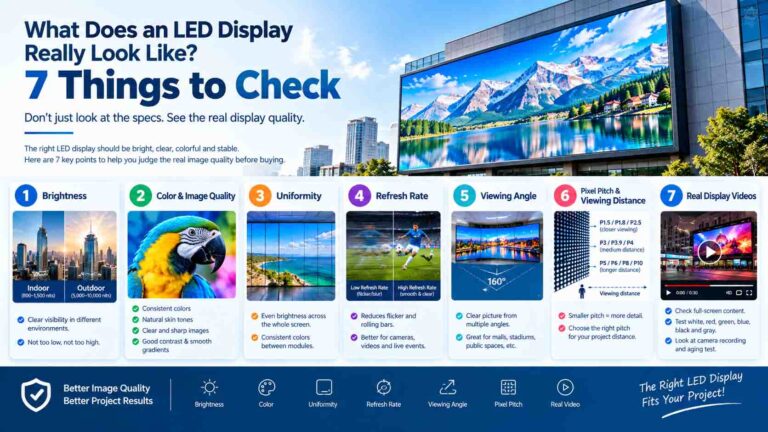
- Refresh rate
- Grayscale
- Image stability
- Brightness consistency
- Long-term reliability
For projects such as stadiums, advertising screens, and live events, the control and driver components are especially important.
A professional supplier should be able to provide a complete configuration rather than only quoting the pixel pitch.
3. What Power Supply Is Used?
The power supply directly affects the stability of an LED display.
You should check:
- Power supply brand
- Rated power
- Input voltage
- Efficiency
- Protection functions
- Quantity per cabinet
For example, a large outdoor LED display may require multiple power supplies in each cabinet to provide sufficient power and redundancy.
The power supply should also be suitable for the destination country’s electrical requirements.
4. Is Every Screen Tested Before Shipment?
A reliable LED display should not simply be assembled and packed immediately.
A proper production process normally includes:
Module Testing → Cabinet Assembly → Aging Test → Full Display Testing → Quality Inspection → Packaging
The aging test is particularly important.
During aging, the screen is continuously operated to help identify potential problems before shipment.
When evaluating a supplier, ask:
Can you provide photos or videos of the aging test before shipment?
This is often more useful than simply looking at a product specification sheet.
5. How Is the Screen Protected Against Weather?
For outdoor LED displays, environmental protection is critical.
You should check:
- Waterproof design
- Cabinet sealing
- IP protection level
- Cooling system
- Operating temperature
- Corrosion protection
- Wind resistance
An outdoor LED display may be exposed to rain, dust, sunlight, humidity, and temperature changes for many years.
Therefore, outdoor quality is not only about the LED module—it also depends on the entire cabinet and system design.
6. Can the Supplier Provide Spare Parts?
Even a well-designed LED display may eventually require maintenance.
A professional supplier should be able to provide spare parts such as:
- LED modules
- Power supplies
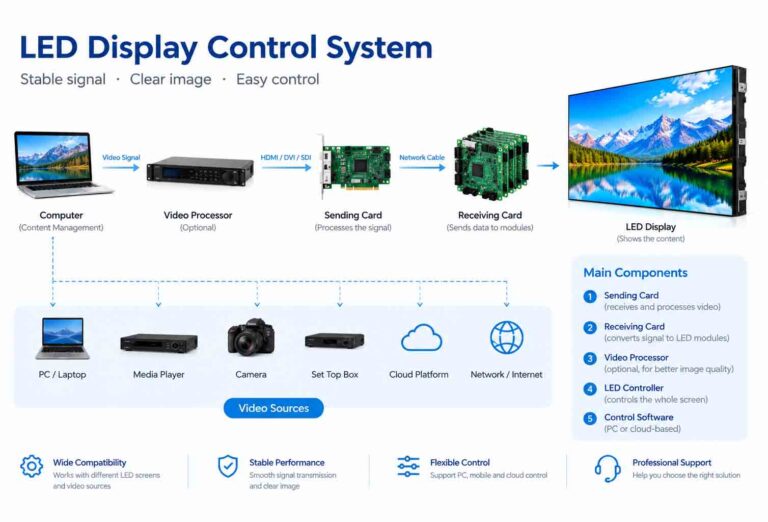
- Receiving cards
- Cables
- Masks
- Other critical components
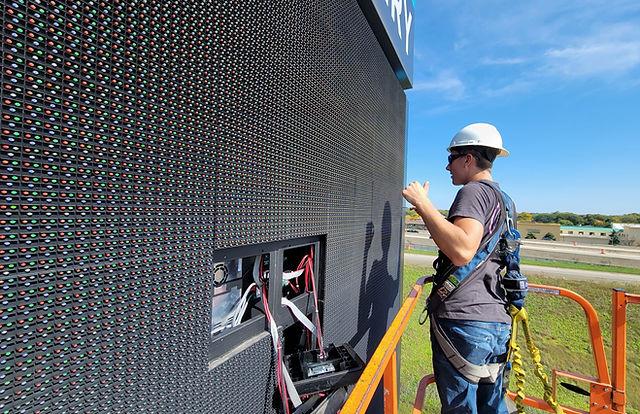
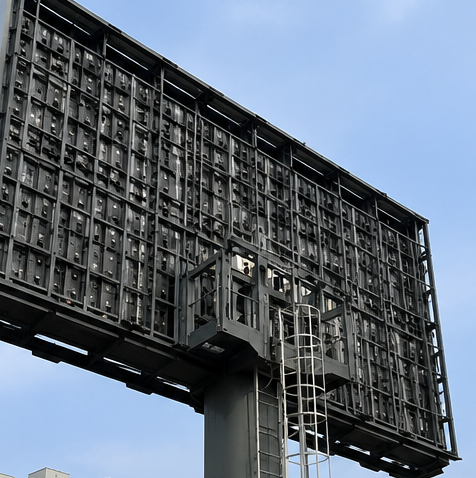
It is also important to ask how easily a damaged module or power supply can be replaced.
Easy maintenance can significantly reduce downtime and service costs.
7. Does the Supplier Have a Quality Control Process?
Don’t only ask:
“Is your LED display high quality?”
Instead, ask the supplier to show you how quality is controlled.
For example:
- Incoming component inspection
- Module testing
- Cabinet inspection
- Aging testing
- Brightness and color testing
- Final inspection
- Packaging inspection
Factory photos, production videos, aging-test videos, and real project cases can also help you understand the supplier’s production process.
Quality Is More Than Just a Specification
A reliable LED display is not determined by one parameter.
You should look at the complete system:
LED + Driver IC + PCB + Power Supply + Cabinet + Control System + Testing + Quality Control
Two LED displays may have the same P3.91 specification, but their component selection, manufacturing process, testing standards, and long-term performance can be very different.
That’s why comparing only the price per square meter can be misleading.
Before You Order: Ask These Questions
Before purchasing an LED display, ask your supplier:
☐ What LED brand is used?
☐ What driver IC is used?
☐ What power supply is used?
☐ What is the refresh rate?
☐ How long is the aging test?
☐ What quality tests are performed?
☐ What is the outdoor protection level?
☐ Are spare parts included?
☐ What is the warranty period?
☐ Can you provide real project cases?
The more transparent the supplier is about these questions, the easier it is to evaluate the product before placing an order.
Choose a Supplier, Not Just a Product
When purchasing an LED display, you are not only buying LED modules and cabinets.
You are also choosing a long-term supplier and technical partner.
A reliable supplier should provide:
Consistent quality + Transparent configuration + Proper testing + Technical support + After-sales service
Before comparing prices, make sure you are comparing the same quality and the same configuration.