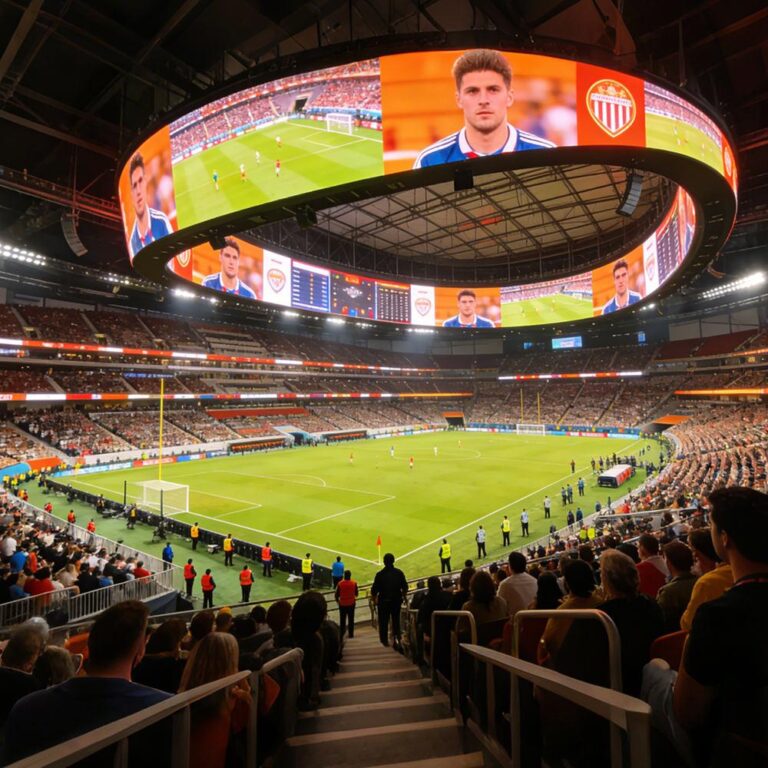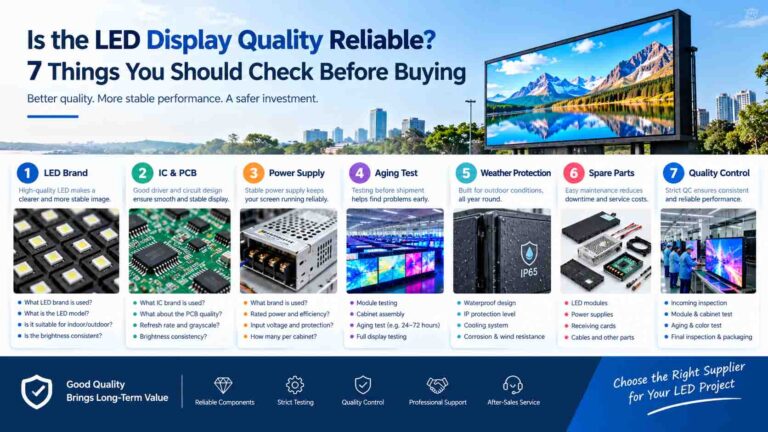
Choosing an LED display is not simply about selecting P2, P3, P4, or P5. The right LED screen depends on your viewing distance, installation environment, screen size, brightness requirements, maintenance conditions, and budget.
Many LED display projects experience unnecessary costs because the screen was selected based only on price or pixel pitch.
Before placing an order, there are several important questions you should answer.
In this guide, we explain how to choose the right LED display for your project.
1. Where Will the LED Display Be Installed?
The first question is whether the screen will be used indoors or outdoors.
Indoor LED Display
Indoor LED displays are commonly used for:
- Meeting rooms
- Shopping malls
- Retail stores
- Churches
- Conference centers
- Control rooms
- Exhibition halls
- Corporate lobbies
Indoor screens normally do not need extremely high brightness because they are protected from direct sunlight.
Typical brightness is approximately 800–1,500 nits, depending on the application and ambient lighting.
Outdoor LED Display
Outdoor LED displays are designed for environments exposed to sunlight, rain, dust, and temperature changes.
Common applications include:
- Outdoor advertising billboards
- Stadiums
- Shopping mall façades
- Transportation hubs
- Building signage
- Public information displays
- Roadside advertising
Outdoor LED displays generally require much higher brightness, often around 5,000–10,000 nits, depending on the installation environment.
For outdoor projects, you should also consider:
- Waterproof protection
- Cabinet structure
- Heat dissipation
- Wind load
- Maintenance method
- Operating temperature
Do not select an outdoor LED screen simply because it has a higher brightness specification. The correct brightness depends on the actual installation environment.
2. What Is the Viewing Distance?
One of the most important factors when selecting an LED display is viewing distance.
Pixel pitch refers to the distance between the centers of two adjacent LED pixels.
For example:
- P1.5 = 1.5 mm pixel pitch
- P2 = 2 mm
- P2.5 = 2.5 mm
- P3 = 3 mm
- P4 = 4 mm
- P5 = 5 mm
- P6 = 6 mm
- P8 = 8 mm
- P10 = 10 mm
Generally, a smaller pixel pitch provides higher pixel density and better image detail at close viewing distances.
However, smaller pixel pitch does not automatically mean a better choice.
For example, if an outdoor billboard is located 30–50 meters away from viewers, using a very fine-pitch LED display may significantly increase the project cost without providing a meaningful visual benefit.
Therefore, always consider the actual viewing distance before selecting the pixel pitch.
3. How Large Is the Screen?
Screen size also affects your LED display selection.
A large outdoor billboard may use a larger pixel pitch because viewers are usually far away.
A small indoor meeting room display, on the other hand, may require a smaller pixel pitch because viewers are sitting much closer to the screen.
For example:
| Application | Typical Pixel Pitch |
|---|---|
| Meeting room | P1.2–P2.5 |
| Corporate lobby | P1.5–P2.5 |
| Retail store | P1.8–P3 |
| Exhibition hall | P1.8–P3.9 |
| Outdoor advertising | P3.9–P10 |
| Stadium perimeter | P6–P10 |
| Large outdoor billboard | P6–P10+ |
These ranges are only general references. The actual pixel pitch should be determined according to the viewing distance, content requirements, screen size, and project budget.
4. What Content Will Be Shown on the Screen?
Think about what your LED display will actually show.
Will you display:
- Text?
- Logos?
- Product images?
- Videos?
- Sports scores?
- Advertising content?
- Live camera feeds?
- Financial information?
- Data from a cloud platform?
Different applications can have different requirements.
For example, a screen displaying detailed product images in a shopping mall may benefit from a finer pixel pitch.
A roadside advertising screen mainly displaying large advertisements may not need extremely fine pixel pitch.
For sports applications, you may also need to consider:
- High refresh rate
- Camera-friendly performance
- Fast image response
- Wide viewing angle
- Real-time data integration
Therefore, content should be considered together with viewing distance when selecting pixel pitch.
5. How Bright Does the Screen Need to Be?
Brightness is particularly important for outdoor LED displays.
If a screen is installed in direct sunlight, insufficient brightness can make the content difficult to see.
However, excessively high brightness can also result in:
- Higher power consumption
- More heat
- Increased operating costs
- Excessive brightness at night
For outdoor projects, you should consider whether the screen has:
Automatic Brightness Adjustment
A light sensor can detect ambient light and automatically adjust screen brightness.
For example:
Daytime → Higher brightness
Cloudy weather → Medium brightness
Night → Lower brightness
This can improve visibility while reducing unnecessary energy consumption.
6. Do You Need Front Maintenance or Rear Maintenance?
Maintenance access is often overlooked during the purchasing stage.
Ask yourself:
Can technicians access the back of the LED screen after installation?
If the screen is installed against a wall, inside a narrow space, or on a building façade, rear maintenance may be difficult or impossible.
In these situations, a front-maintenance LED display may be a better solution.
Front-maintenance designs allow technicians to remove LED modules or access components from the front.
For large outdoor screens with sufficient maintenance space behind the display, rear maintenance may also be a practical option.
The correct choice depends on the installation structure.
7. What Are the Local Weather Conditions?
For outdoor LED displays, the local environment matters.
Before ordering, consider:
- Rain
- Humidity
- Dust
- Snow
- High temperature
- Low temperature
- Strong sunlight
- Coastal salt air
- Strong wind
For example, a coastal installation may require additional protection against corrosion.
A hot climate requires good thermal management.
A high-wind location requires careful consideration of the cabinet structure and supporting steel structure.
Therefore, don’t simply ask:
“Is the screen waterproof?”
Instead, ask:
“Is this LED display suitable for my actual installation environment?”
8. What Power Supply and Electrical Conditions Are Available?
LED displays can consume significant amounts of electricity, especially large outdoor screens.
Before placing an order, confirm:
- Local voltage
- Frequency
- Maximum power consumption
- Average power consumption
- Power supply configuration
- Number of power supplies
- Power distribution requirements
For an international project, the electrical configuration should match the destination country and project requirements.
For example, European projects may have different requirements from projects in other regions.
The power system should therefore be confirmed together with the LED display configuration rather than treated as an afterthought.
9. What Control System Do You Need?
The LED cabinet is only one part of a complete LED display system.
You may also need:
- Sending card
- Receiving card
- Video processor
- Media player
- Control software
- Wi-Fi or network connection
- 4G/5G connection
- Cloud monitoring
- Data integration
Common control system brands include NovaStar and Huidu, depending on the project requirements.
For special applications, the LED display may also need to connect with an external data source or software platform.
For example:
Cloud API → Media Player → LED Display
or
RS485 / Modbus → Controller → LED Display
If your project requires real-time data, make sure the control system supports the required communication method before ordering the screen.
10. What Is Your Total Project Budget?
Price per square meter is important, but it should not be the only consideration.
A complete LED display project may include:
LED cabinets + LED modules + receiving cards + sending system + video processor + power distribution + spare parts + cables + structure + packaging + transportation + installation
Therefore, when comparing suppliers, make sure you are comparing the same configuration.
For example:
Supplier A: €500/m²
Supplier B: €600/m²
This does not necessarily mean Supplier A is cheaper.
One quotation may include a complete control system and spare parts, while another may only include the LED cabinets.
Always compare the complete BOM and total project cost.
Before placing an order, you can use the following checklist:
A Simple LED Display Selection Checklist
☐ Indoor or outdoor?
☐ Screen size?
☐ Viewing distance?
☐ Recommended pixel pitch?
☐ Required brightness?
☐ Content type?
☐ Required refresh rate?
☐ Front or rear maintenance?
☐ Local weather conditions?
☐ Local voltage and electrical requirements?
☐ Control system?
☐ Installation method?
☐ Steel structure requirements?
☐ Estimated power consumption?
☐ Spare parts?
☐ Warranty and after-sales support?
☐ Total project cost?
If these questions have been answered clearly, you are much closer to selecting the right LED display for your project.
Don’t Choose an LED Display by Pixel Pitch Alone
One of the most common mistakes when purchasing an LED display is asking only:
“How much is P3?”
A professional LED display selection should consider the entire project.
The right solution is determined by a combination of:
Viewing Distance + Installation Environment + Screen Size + Content + Brightness + Maintenance + Control System + Budget
A P2.5 screen may be the right solution for one project, while P4, P5, P6, or P8 may be more appropriate for another.
There is no single pixel pitch that is best for every project.
Need Help Choosing the Right LED Display?
If you are planning an LED display project but are not sure which pixel pitch, cabinet type, brightness, or control system you need, you can send us your basic project information.
We can help you evaluate:
- Recommended pixel pitch
- Indoor/outdoor solution
- Cabinet size
- Brightness
- Control system
- Power requirements
- Maintenance method
- Estimated configuration and BOM
Simply send us your screen size, viewing distance, installation location, and application.
We will recommend a suitable LED display solution based on your project requirements.