When buying an LED display, many customers have the same concern:
What happens if the LED screen has a problem after installation? Who will fix it? How long will it take?
A reliable LED display supplier should provide clear after-sales support and an easy maintenance solution.
1. What Problems Can an LED Display Have?
Common LED display problems include:
- Some LED modules are not working
- Black or dark areas on the screen
- Color or brightness differences
- Power supply failure
- Receiving card problems
- Loose cables or connectors
- Water or moisture problems on outdoor screens
- Control system or software problems
Most of these problems can be solved by replacing the faulty component or checking the system step by step.
2. Who Is Responsible for the Repair?
Before placing an order, customers should clearly understand the supplier’s LED display warranty and after-sales service.
A professional supplier should explain:
- Warranty period
- What is covered by the warranty
- Which parts are covered
- How technical support is provided
- How replacement parts are handled
- How remote troubleshooting works
For international projects, remote technical support is especially important because the supplier and installation site may be in different countries.
3. How Is an LED Display Repaired?
Most LED displays are designed with replaceable components.
A typical repair process is:
Step 1: Check the problem
Step 2: Identify the faulty component
Step 3: Replace the module, power supply, receiving card or cable
Step 4: Test the screen
Step 5: Confirm that the display is working normally
For many common problems, customers do not need to replace the entire LED screen.
4. Is Front Maintenance or Rear Maintenance Better?
This depends on the installation environment.
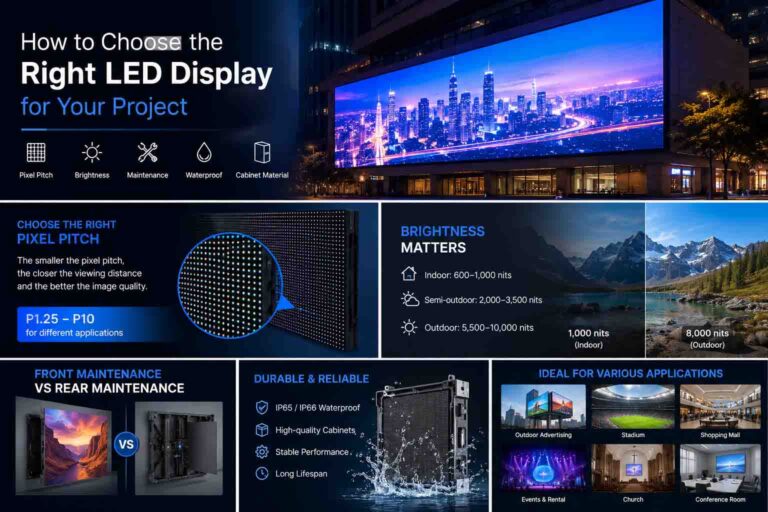
Front maintenance is useful when there is limited space behind the LED display. Modules and some components can be accessed from the front.
Rear maintenance is suitable when there is enough space behind the screen for technicians to work.
Before ordering, customers should tell the supplier about the installation conditions. The supplier can then recommend the appropriate LED display maintenance solution.
5. Are Spare Parts Important?
Yes.
For long-term LED display projects, it is recommended to keep some spare parts, such as:
- LED modules
- Power supplies
- Receiving cards
- Cables and connectors
- Other important components
Having spare parts available can significantly reduce LED display downtime.
6. What Should You Ask the Supplier Before Buying?
Before ordering an LED display, ask these questions:
- What is the warranty period?
- What does the warranty cover?
- How do you handle LED display failures?
- Can you provide remote technical support?
- Are spare parts available?
- Is the screen front or rear maintenance?
- How quickly can replacement parts be shipped?
- Can you provide repair instructions or videos?
A clear answer to these questions can help reduce maintenance risks after installation.
Conclusion
A good LED display is not only about image quality and hardware specifications.
Reliable after-sales service, easy maintenance and available spare parts are also important.
Before buying an LED display, make sure you understand the LED display warranty, maintenance method, spare parts and technical support.
The right supplier should support your project not only before delivery, but also after the LED display is installed.